
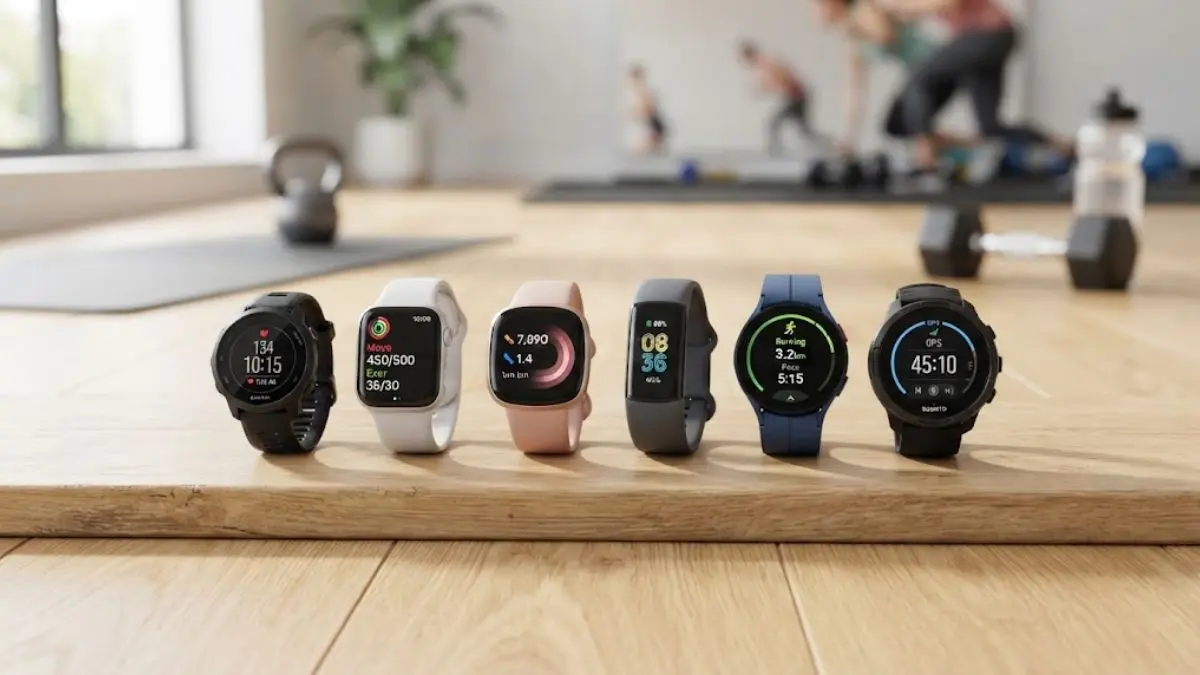
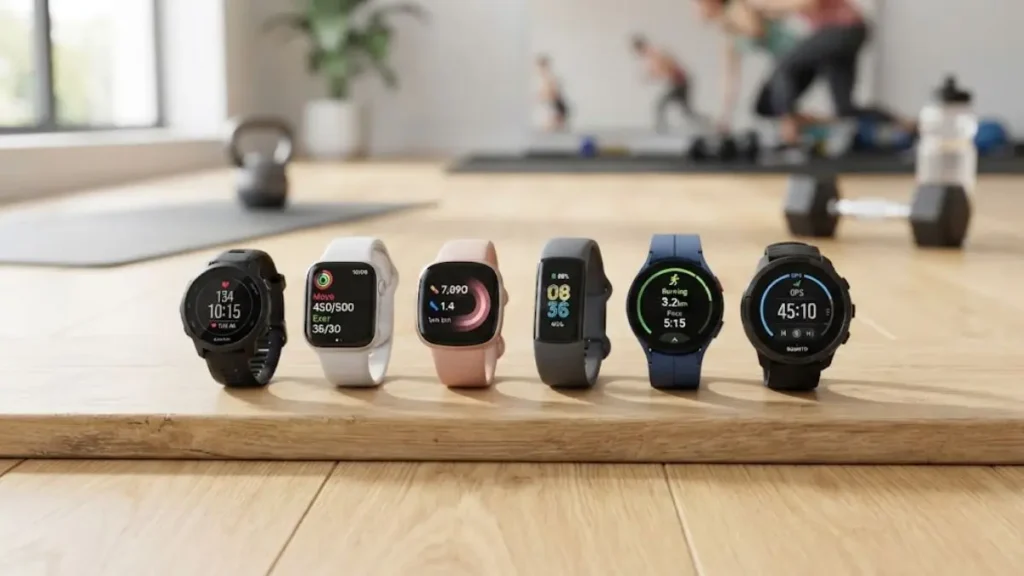
The best fitness trackers can do much more than count your daily steps. Modern trackers and watches can monitor workouts, heart rate, sleep, recovery, GPS activity, and other useful health and fitness information. The challenge is choosing a device that actually fits your routine instead of paying for features you may never use.
For this guide, we compared 12 notable fitness trackers and watches for different types of users, including beginners, runners, walkers, outdoor athletes, and people who mainly want sleep or wellness tracking. The right choice depends on your phone, fitness goals, preferred design, battery needs, and how much smartwatch functionality you want.
The 12 Best Fitness Trackers & Watches of 2026
1. Garmin Vivoactive 6 — Best Overall
The Garmin Vivoactive 6 is one of the strongest all-around choices for people who want detailed fitness tracking without moving into Garmin’s most expensive sports watches. It combines a compact AMOLED display with built-in GPS, activity tracking, heart-rate monitoring, sleep features, and a wide range of workout tools.
Its battery life is another major advantage. Garmin lists up to 11 days of battery life, although actual results depend on settings and usage. It also works with both Android and iPhone, making it a flexible choice among the best fitness trackers compared with some smartwatch alternatives.
Best for: Everyday fitness, walking, gym workouts, and users who want long battery life.
Main drawback: It does not offer the same level of smartphone integration as a premium Apple or Samsung smartwatch.
2. Samsung Galaxy Fit 3 — Best Budget Fitness Tracker
The Samsung Galaxy Fit 3 is a simple option for people who want useful activity tracking without paying smartwatch prices. It has a bright AMOLED display, sleep tracking, workout monitoring, and a lightweight design.
One of its biggest advantages is battery life, with Samsung’s tracker capable of lasting for many days between charges. Current 2026 comparisons continue to highlight it as a strong budget choice, although it does not have built-in GPS.
Best for: Beginners and Android users who want affordable daily tracking.
Main drawback: No built-in GPS means outdoor route tracking depends on a connected phone.
3. Fitbit Air — Best Screen-Free Tracker
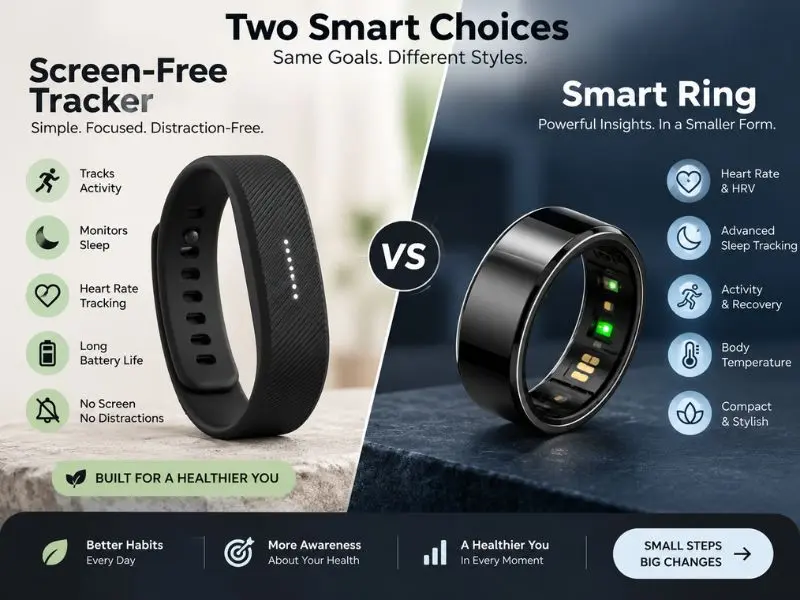
The Fitbit Air takes a different approach. Instead of giving you another screen to check throughout the day, it focuses on quietly collecting fitness and wellness information.
It can track common metrics such as activity, heart rate, and sleep while connecting with Google’s health ecosystem. Its small, screen-free design may appeal to people who want useful data without constant notifications.
Current 2026 reviews highlight its lightweight design and roughly seven-day battery life as major strengths, making it one of the best fitness trackers for everyday use.
Best for: People who want simple, distraction-free tracking.
Main drawback: The lack of a screen means you cannot quickly check your workout information directly on the device.
4. Oura Ring 5 — Best for Sleep and Wellness
The Oura Ring 5 is designed for people who prefer a discreet wearable instead of a traditional watch. It sits on your finger and focuses heavily on sleep, recovery, readiness, and general wellness information.
Its design makes it easier to wear overnight than some larger watches. It is also a good choice for users who do not want a bright display or constant notifications.
The biggest consideration is price. It is positioned as a premium wearable, so it makes more sense for someone who values detailed wellness insights rather than simply counting steps. Current 2026 comparisons list battery life of up to around nine days.
Best for: Sleep, recovery, and discreet everyday tracking.
Main drawback: It is not a traditional fitness watch and does not provide the same on-device workout experience as a sports watch.
5. Amazfit Helio Strap — Best Screen-Free Value
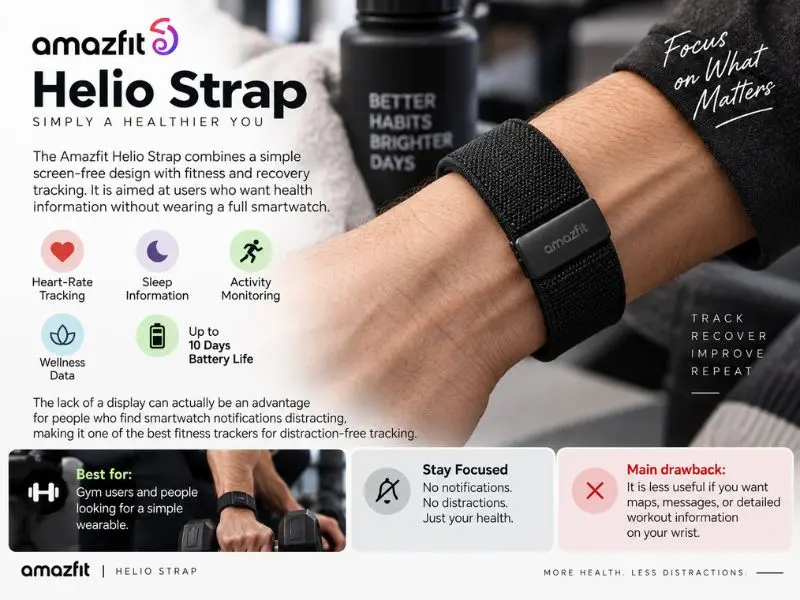
The Amazfit Helio Strap combines a simple screen-free design with fitness and recovery tracking. It is aimed at users who want health information without wearing a full smartwatch.
Its feature set includes heart-rate tracking, sleep information, activity monitoring, and other wellness data. Current comparisons list a battery life of around 10 days, depending on use.
The lack of a display can actually be an advantage for people who find smartwatch notifications distracting, making it one of the best fitness trackers for distraction-free tracking.
Best for: Gym users and people looking for a simple wearable.
Main drawback: It is less useful if you want maps, messages, or detailed workout information on your wrist.
6. Apple Watch SE 3 — Best for iPhone Users
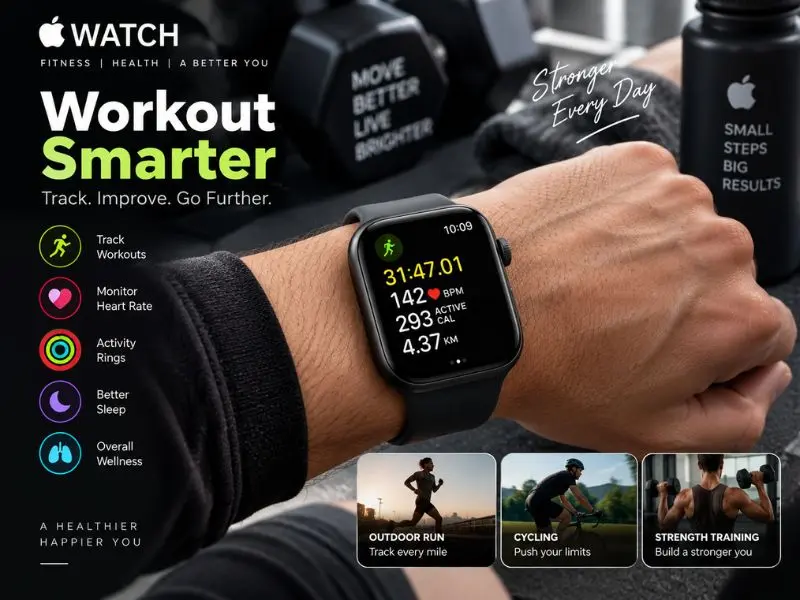
The Apple Watch SE 3 is a strong choice for iPhone owners who want fitness tracking combined with everyday smartwatch features. It offers built-in GPS, activity tracking, heart-rate features, workout support, and access to Apple’s wider watch ecosystem.
Its main advantage is versatility. You can use it for walking and workouts while also handling notifications and other everyday functions.
The trade-off is battery life. Current comparisons list around 18 hours under the specified usage conditions, meaning it requires much more frequent charging than many dedicated fitness bands.
Best for: iPhone users who want fitness tracking and smartwatch features in one device.
Main drawback: Battery life is much shorter than many fitness-focused trackers.
7. Garmin Cirqa — Best Screen-Free Garmin
The Garmin Cirqa is aimed at people who want Garmin’s fitness ecosystem without a traditional watch display. It tracks activities, sleep, stress, recovery, and other fitness information while keeping the hardware relatively simple.
For runners and gym users, the device can provide useful post-workout information through Garmin Connect. However, it does not have onboard GPS, so users who want route tracking need to consider how they use it with a phone.
Its screen-free approach can also help reduce distractions during the day, making it a practical option among the best fitness trackers.
Best for: Runners and fitness users who prefer a minimalist wearable.
Main drawback: No built-in GPS and no screen for viewing workout information.
8. Google Pixel Watch 5 — Best Fitbit-Powered Smartwatch
The Google Pixel Watch 5 brings Fitbit’s health and fitness tracking into a full smartwatch format. It is particularly attractive to Android users who want workout and wellness features alongside apps, notifications, and Google’s ecosystem.
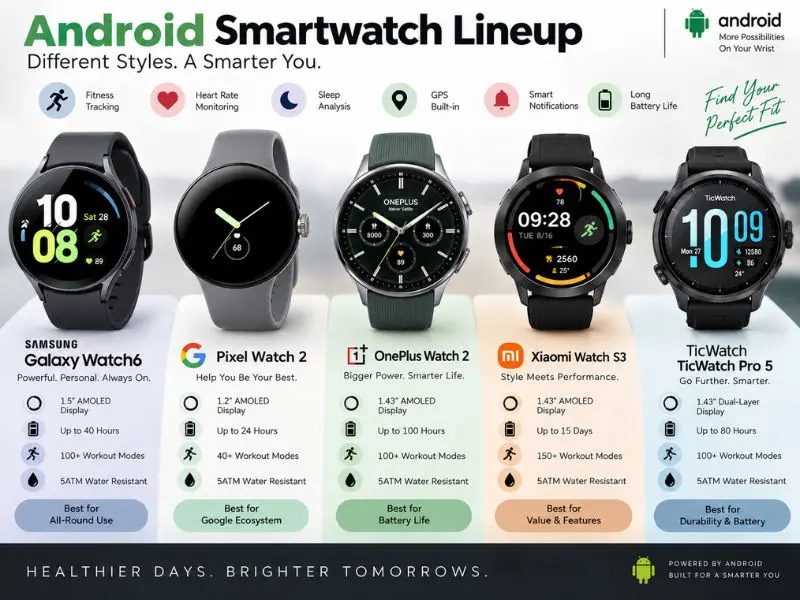
It offers a bright AMOLED display and a broad set of health and activity features. Recent comparisons also highlight improvements to performance and battery life over earlier Pixel Watch generations.
It is a better choice than a basic tracker for people who want a device that feels like a smartwatch first and fitness tracker second.
Best for: Android users who want fitness and smartwatch features together.
Main drawback: Battery life remains shorter than dedicated fitness trackers.
9. Samsung Galaxy Watch 9 — Best Samsung Fitness Watch
The Samsung Galaxy Watch 9 is designed for users who want a full smartwatch with substantial health and fitness capabilities. It combines workout tracking, GPS, health features, notifications, apps, and Samsung’s broader wearable ecosystem.
Recent comparisons report improvements in processing, health features, and battery capacity over the previous generation, although battery life is still one of its weaker areas.
For Samsung phone owners, the integration can make it a particularly convenient option among the best fitness trackers.
Best for: Samsung users who want advanced fitness and smartwatch functionality.
Main drawback: It may require frequent charging compared with dedicated fitness trackers.
10. OnePlus Watch 3 — Best Battery Life for Android Users
The OnePlus Watch 3 stands out for users who dislike charging their watch every day. Current 2026 Android smartwatch comparisons highlight battery life of up to 120 hours, giving it a major advantage over many full-featured smartwatches.
It is suitable for users who want workout tracking, health features, and smartwatch functionality without sacrificing as much battery life.
Best for: Android users who prioritize battery life.
Main drawback: Its larger smartwatch design may be more than a casual tracker user needs.
11. Fitbit Charge 6 — Best Traditional Fitness Band
The Fitbit Charge 6 remains a useful choice for people who want a slim fitness band rather than a large smartwatch. It offers activity tracking, heart-rate monitoring, sleep information, and built-in GPS.
Its smaller design makes it practical for daily wear, workouts, and sleep. It also fits naturally into the Fitbit ecosystem.
The main reason to choose it over a newer smartwatch is simplicity. You get many important fitness features without wearing a large watch, making it a practical choice among the best fitness trackers.
Best for: Everyday activity tracking and users who prefer a traditional fitness band.
Main drawback: The interface and feature set are more limited than a full smartwatch.
12. Xiaomi Smart Band 10 — Best Budget Battery Life
The Xiaomi Smart Band 10 is another strong choice for shoppers who want a low-cost wearable with a long battery life. Current 2026 testing coverage highlights its long-lasting battery and large number of activity-tracking modes.
It is especially attractive for people who mainly care about steps, workouts, sleep, and general activity rather than advanced smartwatch functions.
One important limitation is GPS. Depending on the model and use case, users may need a phone for location tracking rather than relying on built-in GPS.
Best for: Budget-conscious users who want long battery life.
Main drawback: It does not offer the same advanced ecosystem or smartwatch experience as premium models.
Comparison of the Best Fitness Trackers
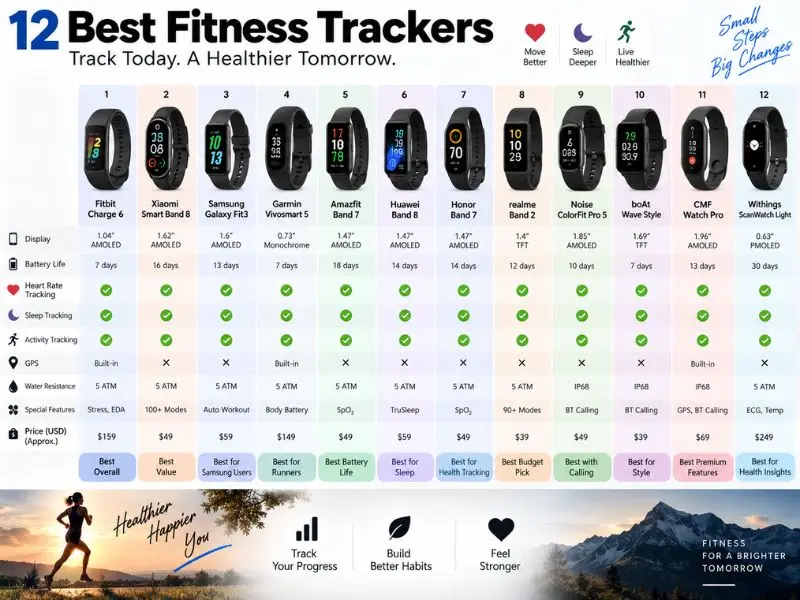
| Fitness Tracker | Best For | GPS | Sleep Tracking | Battery Focus | Device Type |
| Garmin Vivoactive 6 | Overall fitness | Yes | Yes | Up to 11 days | Fitness watch |
| Samsung Galaxy Fit 3 | Budget users | No | Yes | Up to 13 days | Fitness band |
| Fitbit Air | Screen-free tracking | Yes | Yes | Up to 7 days | Screen-free tracker |
| Oura Ring 5 | Sleep and recovery | No | Yes | Up to 9 days | Smart ring |
| Amazfit Helio Strap | Simple fitness tracking | Yes | Yes | Around 10 days | Screen-free band |
| Apple Watch SE 3 | iPhone users | Yes | Yes | About 18 hours | Smartwatch |
| Garmin Cirqa | Screen-free Garmin tracking | No onboard GPS | Yes | Long battery focus | Smart band |
| Google Pixel Watch 5 | Android smartwatch users | Yes | Yes | About 30–40 hours | Smartwatch |
| Samsung Galaxy Watch 9 | Samsung users | Yes | Yes | Shorter than bands | Smartwatch |
| OnePlus Watch 3 | Battery life | Yes | Yes | Up to 120 hours | Smartwatch |
| Fitbit Charge 6 | Fitness band users | Yes | Yes | Multi-day | Fitness band |
| Xiaomi Smart Band 10 | Budget and battery life | No built-in GPS | Yes | Up to 18–21 days depending on source/use | Fitness band |
Specifications and battery estimates can vary according to settings, GPS use, display behavior, software, and other conditions, so advertised maximums should not be treated as guaranteed everyday results. Current 2026 comparisons show substantial differences between dedicated bands, screen-free trackers, rings, and full smartwatches, helping you choose among the best fitness trackers for your needs.
How We Chose the Best Fitness Trackers
A useful fitness tracker should do more than provide a long list of sensors. The most important question is whether the device provides information that you can actually use.
Tracking accuracy matters because unreliable step counts or heart-rate readings can make your data less useful. No wearable is perfect, and results can vary depending on movement, fit, activity, and the individual user.
Workout features are also important. Walkers may only need steps, distance, and heart rate, while runners may want GPS, pace, training information, and recovery tools.
Battery life can make a major difference. A tracker that lasts several days is easier to wear continuously than a smartwatch that needs charging every night.
Comfort is especially important because fitness trackers work best when you wear them consistently. A bulky watch may be fine during a workout but uncomfortable during sleep.
We also considered the overall software experience, phone compatibility, design, available health features, GPS functionality, and value. Current expert comparisons similarly emphasize factors such as accuracy, comfort, battery life, software, training tools, and overall value when evaluating wearables.
How to Choose the Right Fitness Tracker
Start with your main reason for buying one.
If you mainly want step tracking and daily activity, a simple fitness band may be enough. If you also spend a lot of time walking, choosing comfortable footwear such as the best New Balance sneakers can make your daily activity more comfortable. There is little reason to spend hundreds of dollars on a premium smartwatch if you will only use basic features.
If you mainly want step tracking and daily activity, a simple fitness band may be enough. There is little reason to spend hundreds of dollars on a premium smartwatch if you will only use basic features.
If you are a runner, look for built-in GPS, reliable heart-rate tracking, workout profiles, training tools, and enough battery life for your typical sessions.
For sleep tracking, comfort becomes especially important. A smaller band or smart ring may be easier to wear overnight than a large smartwatch.
If you are a gym user, consider heart-rate tracking, workout modes, recovery information, and whether the device can stay comfortable during strength training.
For outdoor activities, GPS, navigation, durability, water resistance, and battery life should receive more attention.
Finally, consider your phone. Apple Watch models make the most sense for iPhone users, while Samsung and Google watches are particularly attractive within the Android ecosystem. Cross-platform compatibility varies, so check compatibility before buying to choose from the best fitness trackers for your device.
Are Fitness Trackers Worth It?
Fitness trackers can be worthwhile when they help you understand your activity and stay consistent with your goals. Seeing daily steps, workout duration, sleep patterns, or heart-rate information can make your routine easier to monitor.
However, you do not need the most expensive device to benefit. A basic tracker can be enough for someone who wants daily movement and sleep information, while a runner or outdoor athlete may benefit from a more advanced GPS watch.
The best approach is to buy according to the features you will actually use. More sensors and more smartwatch functions do not automatically mean a better experience.
FAQs
1. What is the best fitness tracker for most people?
The Garmin Vivoactive 6 is a strong all-around choice because it combines fitness features, GPS, a long battery life, and broad phone compatibility.
2. Are fitness trackers accurate for counting steps?
Fitness trackers can provide useful step estimates, but counts may vary depending on movement, device placement, walking style, and the individual device.
3. Which fitness tracker has the best battery life?
The Xiaomi Smart Band 10 and other dedicated fitness bands generally offer much longer battery life than full-featured smartwatches, while the OnePlus Watch 3 stands out among Android smartwatches for battery endurance.
4. Can fitness trackers monitor sleep?
Yes, many modern fitness trackers and smartwatches can record sleep duration and provide additional sleep-related measurements, although the depth of information varies by device.
5. Is a fitness tracker better than a smartwatch?
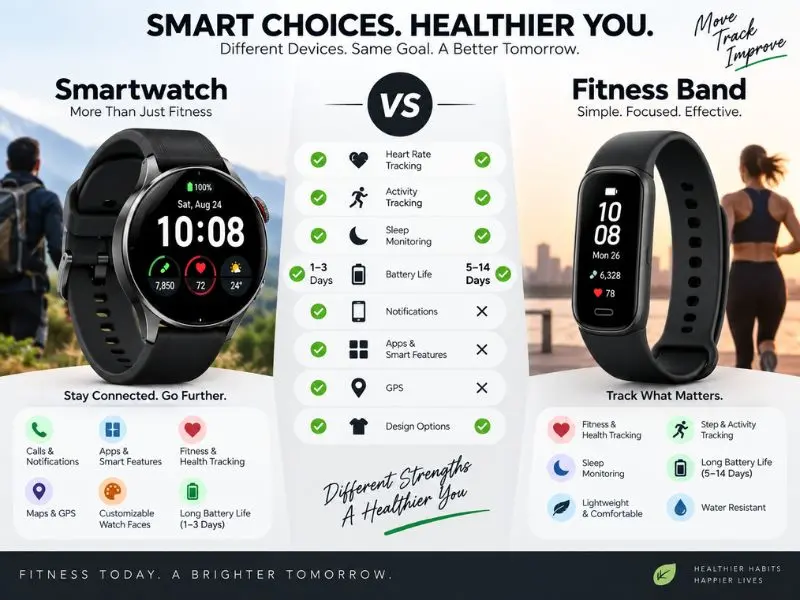
A fitness tracker is usually better for simple activity and health monitoring with longer battery life, while a smartwatch is better if you also want apps, notifications, calls, and other smart features.
Conclusion
The best fitness trackers are not necessarily the most expensive or feature-packed models. The right choice depends on what you want to monitor, how often you exercise, how long you want the battery to last, and which phone you use. For an all-around fitness-focused option, the Garmin Vivoactive 6 is a strong choice, while simpler options such as the Samsung Galaxy Fit 3 or Xiaomi Smart Band 10 can make more sense for budget-focused users. If you want a full smartwatch, models from Apple, Google, Samsung, and OnePlus offer a broader mix of fitness and everyday features.
