
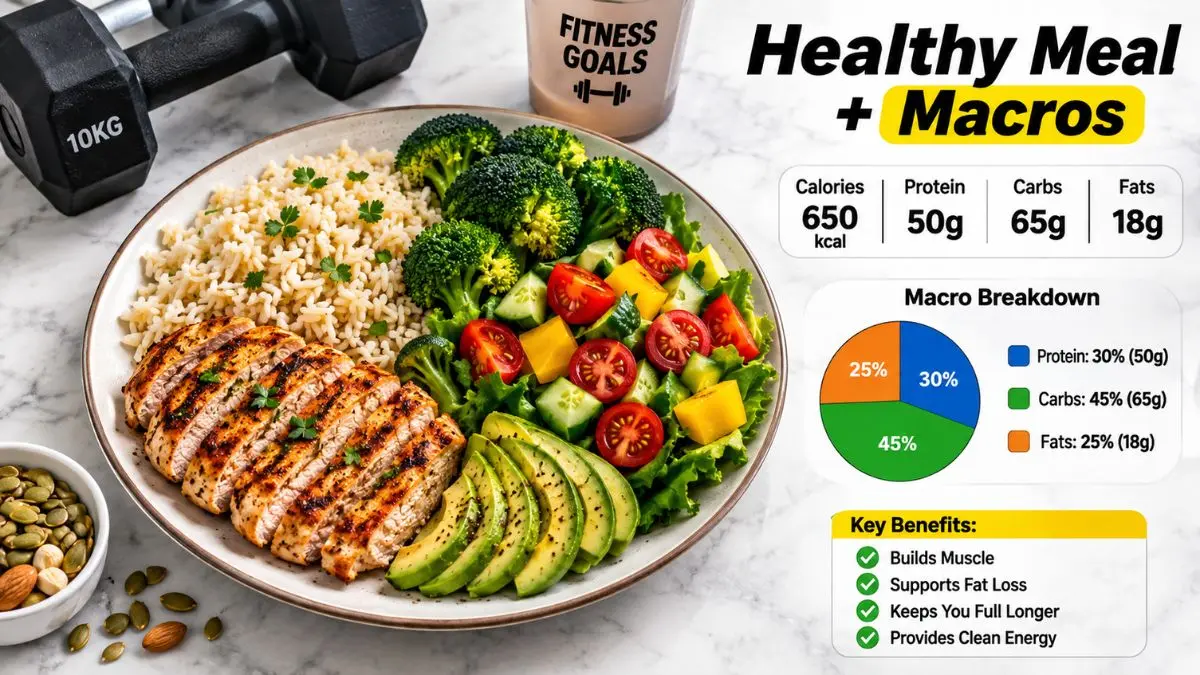
If you want to lose body fat while building or maintaining muscle, macros for weight loss and muscle gain can help you organize your nutrition around calories, protein, carbohydrates, and fats. Instead of following a strict food list, tracking macros gives you more flexibility while keeping your nutrition focused on your goal.
The key is finding a calorie intake and macro balance that supports gradual fat loss without making it unnecessarily difficult to train and recover. In this guide, you will learn how macros work, how to calculate macros for weight loss and muscle gain, how much protein to eat, how to adjust your numbers, and which common mistakes to avoid.
What Are Macros for Weight Loss and Muscle Gain?
Macros, short for macronutrients, are the nutrients your body needs in relatively large amounts. The three main macronutrients are protein, carbohydrates, and dietary fat.
Each macronutrient plays a different role:
- Protein helps support muscle repair and maintenance.
- Carbohydrates provide energy for training and daily activity.
- Fat supports normal hormone function, cell health, and nutrient absorption.
Calories are also important because your total energy intake affects whether your body tends to lose, maintain, or gain weight.
When planning macros for weight loss and muscle gain, the goal is usually to create a small calorie deficit while eating enough protein and maintaining a balanced intake of carbohydrates and fats.
This approach is often called body recomposition because the goal is to improve body composition rather than simply make the scale move downward.
For example, someone weighing 180 pounds may want to gradually reduce body fat while maintaining or increasing lean muscle. Instead of dramatically cutting calories, they could use a moderate deficit, prioritize protein, perform resistance training, and monitor their progress.
Protein, Carbs, and Fat Explained
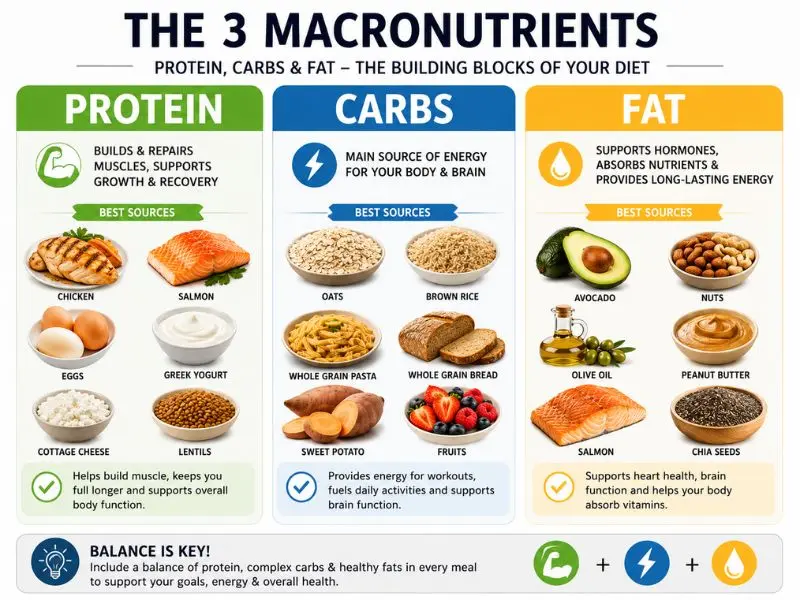
Protein contains about 4 calories per gram, while carbohydrates also provide about 4 calories per gram. Each gram of fat contains roughly 9 calories.
This difference matters when you build a daily meal plan.
For example, a meal containing 30 grams of protein, 40 grams of carbohydrates, and 15 grams of fat would provide approximately 415 calories.
Understanding these numbers can make macro tracking easier because you can adjust portions without completely changing the foods you enjoy.
Why Are Macros for Weight Loss and Muscle Gain Important?
Counting macros is not required for everyone. However, it can be useful when you want more control over your calorie and nutrient intake.
A well-planned macro target may help you:
- Maintain adequate protein intake
- Control overall calorie intake
- Fuel resistance training
- Build balanced meals
- Reduce unnecessary restriction
- Adjust portions based on progress
- Understand how different foods affect your daily intake
One major advantage is flexibility.
You do not necessarily need to eat chicken, rice, and broccoli every day. You can build meals around foods you enjoy while still working toward your protein, carbohydrate, fat, and calorie targets.
However, macro tracking should not become an excuse to ignore food quality. Fruits, vegetables, whole grains, lean proteins, beans, nuts, seeds, and other nutrient-dense foods can provide vitamins, minerals, fiber, and other nutrients that are important for overall health.
The goal is not to make every number perfect. The goal is to create a nutrition system that is realistic enough to follow consistently.
How to Calculate Macros for Weight Loss and Muscle Gain
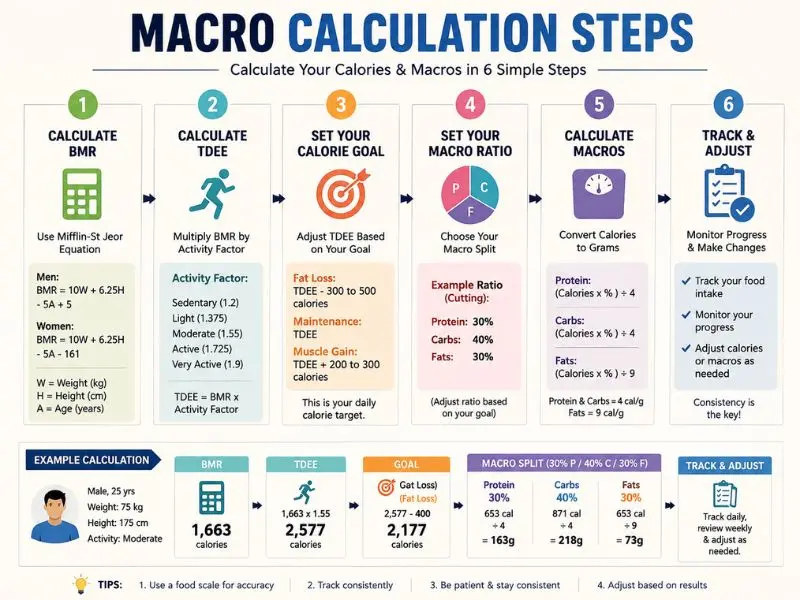
Learning how to calculate macros for weight loss and muscle gain involves several steps. You first estimate your calorie needs, choose an appropriate calorie target, set protein, and then divide the remaining calories between carbohydrates and fats.
Step 1: Estimate Your Maintenance Calories
Your maintenance calories are the approximate amount of energy you need to maintain your current body weight.
Your maintenance needs depend on several factors, including:
- Age
- Sex
- Body weight
- Height
- Daily activity
- Exercise
- Muscle mass
- Lifestyle
Online calorie calculators can provide a starting estimate, but they are not perfectly accurate.
Your actual maintenance intake becomes easier to understand when you track your body weight and food intake over several weeks.
If your average weight remains relatively stable while eating a certain number of calories, that intake may be close to your maintenance level.
Step 2: Create a Moderate Calorie Deficit
If fat loss is your primary goal, you generally need to consume fewer calories than you use over time.
For someone trying to preserve or build muscle, an aggressive calorie deficit may make training and recovery more difficult.
A moderate deficit is often a more practical starting point.
For example, if your estimated maintenance intake is 2,400 calories, you might begin around 2,000–2,200 calories rather than immediately dropping to a very low intake.
The appropriate target varies from person to person.
Step 3: Set Your Protein Target
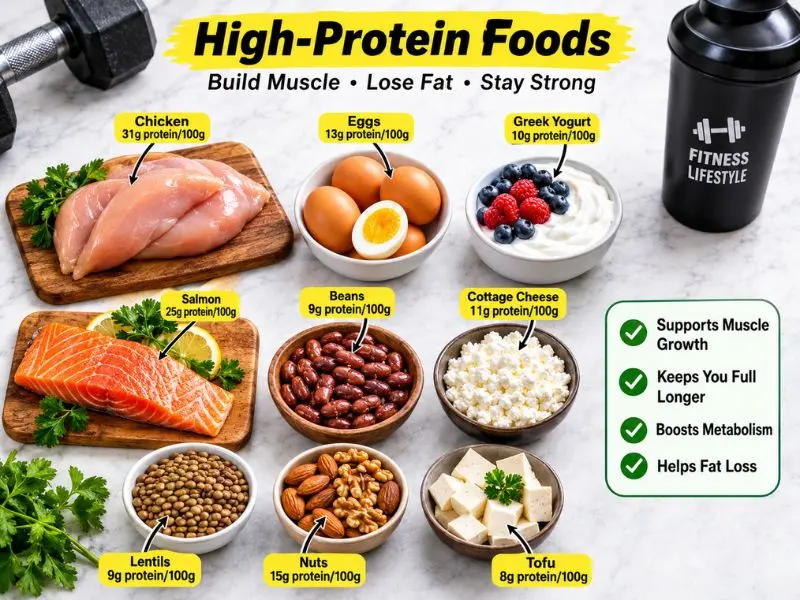
Protein deserves special attention when your goal is to lose fat and gain muscle or preserve existing muscle.
A commonly used range for active adults is approximately 1.6–2.2 grams of protein per kilogram of body weight per day, although individual needs can vary.
For a person who weighs 180 pounds (about 82 kg), that would equal approximately 131–180 grams of protein per day.
You don’t need to reach the exact same protein target every day.
Instead, choose a reasonable target that you can consistently achieve.
Good protein sources include:
- Chicken and turkey
- Lean beef
- Fish and seafood
- Eggs
- Greek yogurt
- Cottage cheese
- Milk
- Tofu and tempeh
- Beans and lentils
- Protein powder
Step 4: Set Your Dietary Fat Intake
Dietary fat is an important part of a balanced diet.
Instead of eliminating fat during weight loss, include reasonable portions of foods such as:
- Avocado
- Nuts
- Seeds
- Olive oil
- Peanut butter
- Fatty fish
- Eggs
A practical approach is to keep fat at a moderate level after setting protein and then use carbohydrates to fill much of the remaining calorie budget.
Individual preferences matter here. Some people feel better with more carbohydrates, while others prefer a somewhat higher-fat diet.
Step 5: Fill the Remaining Calories With Carbohydrates
After setting calories, protein, and fat, carbohydrates can make up the remaining calories.
Carbohydrates can be particularly useful around workouts because they provide a convenient source of energy.
Useful carbohydrate sources include:
- Oats
- Rice
- Potatoes
- Whole-grain bread
- Pasta
- Beans
- Fruit
- Vegetables
- Quinoa
There is no universal percentage of calories that must come from carbohydrates.
Your training schedule, preferences, calorie target, and other nutritional needs can influence the ideal balance.
Example of a Macro Calculation
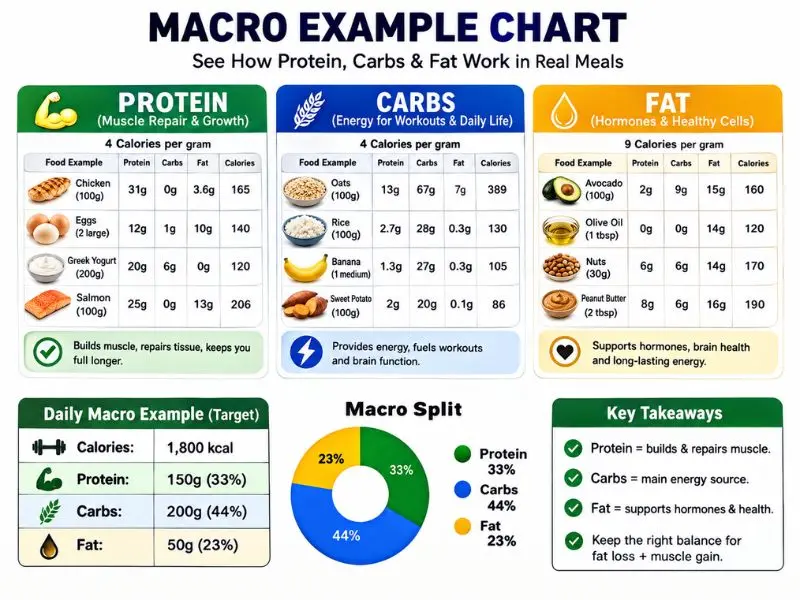
Suppose someone has a daily calorie target of 2,100 calories.
They decide to aim for:
- 160 grams protein
- 65 grams fat
- Remaining calories from carbohydrates
Protein provides 640 calories because 160 × 4 = 640.
Fat provides 585 calories because 65 × 9 = 585.
That leaves 875 calories for carbohydrates.
Because carbohydrates provide 4 calories per gram, 875 ÷ 4 equals approximately 219 grams of carbohydrates.
The resulting daily target would be approximately:
| Macro | Daily Target | Calories |
| Protein | 160 g | 640 |
| Carbohydrates | 219 g | 876 |
| Fat | 65 g | 585 |
| Total | — | 2,101 |
This is only an example, not a personalized prescription.
Your own calorie and macro needs may be higher or lower.
Benefits of Macros for Weight Loss and Muscle Gain
1. They Give Your Nutrition Structure
Macro targets give you a simple framework for planning meals.
Instead of wondering whether your diet contains enough protein or whether your portions are appropriate, you have measurable targets to work toward.
2. They Support Muscle-Friendly Weight Loss
Eating enough protein while performing resistance training can help support muscle retention during a calorie deficit.
This is especially useful for people who want to lose fat without simply becoming lighter.
However, muscle growth also depends on training quality, recovery, calories, sleep, and individual factors.
3. They Allow More Food Flexibility
A macro-based approach can be more flexible than a rigid diet.
You can often include foods you enjoy while still meeting your nutritional targets.
For example, you might have oatmeal and eggs for breakfast, a chicken rice bowl for lunch, Greek yogurt and fruit as a snack, and salmon with potatoes for dinner.
4. They Make Progress Easier to Monitor
If your body weight, waist measurement, strength, and overall progress stop changing, your nutrition may need adjustment.
Tracking macros gives you useful information about what you are actually eating.
This can be more reliable than guessing portion sizes.
5. They Can Improve Meal Planning
Once you understand your targets, preparing meals becomes easier.
You can prepare a protein source, carbohydrate source, vegetables, and healthy fats in advance and combine them into different meals throughout the week.
Best Ways to Use Macros for Weight Loss and Muscle Gain
Prioritize Protein at Each Meal
Instead of eating most of your protein at dinner, spread it across the day.
For example, someone with a 160-gram daily target might divide protein across four meals and snacks rather than trying to consume a very large amount in one sitting.
This can also make meals more satisfying and easier to organize.
Build Meals Around Whole Foods
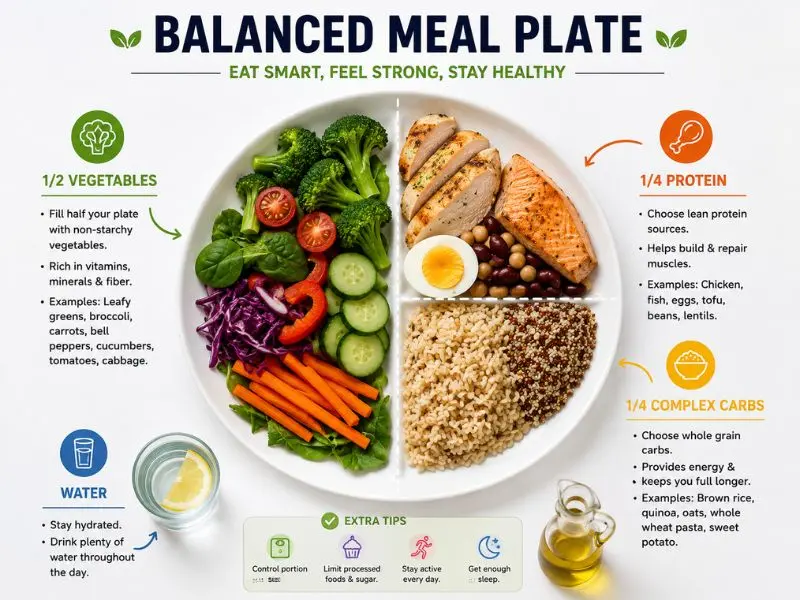
Macro tracking works best when most of your diet contains nutrient-dense foods.
A simple meal formula is:
Protein + carbohydrate + vegetables or fruit + healthy fat
For example:
Chicken + rice + vegetables + avocado
This combination provides protein, carbohydrates, fiber, and fat in one simple meal.
Use Resistance Training
Nutrition alone does not create the best environment for muscle development.
A consistent resistance training program provides the training stimulus your muscles need.
Focus on progressive improvement in exercises such as:
- Squats
- Rows
- Presses
- Deadlifts
- Lunges
- Pull-ups
- Lat pulldowns
You do not need to train every day.
A consistent program that allows enough recovery is more practical than constantly increasing workout volume.
Adjust Calories Based on Progress
Your initial numbers are estimates.
After several weeks, look at trends rather than individual weigh-ins.
If body weight and measurements are not moving in the desired direction, you may need to make a small adjustment to calorie intake or activity.
Avoid changing your calories every few days.
Give your plan enough time to produce a meaningful trend.
Get Enough Sleep
Recovery is an important part of body recomposition.
Most adults should aim for around 7–9 hours of sleep per night, although individual needs vary.
Poor sleep can make it harder to maintain consistent training, food choices, and recovery habits.
Stay Hydrated
Water does not contain calories, but hydration still matters for general health and physical performance.
Keep water available throughout the day and pay attention to your thirst, activity level, climate, and other factors that influence fluid needs.
Macros for Weight Loss and Muscle Gain: Comparison Table
| Approach | Main Benefit | Best For | Pros | Cons |
| Moderate calorie deficit | Supports gradual fat loss | Fat loss with muscle preservation | Sustainable for many people | Progress may be slower |
| High-protein balanced diet | Supports muscle maintenance | Body recomposition | Simple and flexible | Requires protein planning |
| Macro tracking | Improves nutrition awareness | People who like numbers | Precise and adjustable | Can become time-consuming |
| Portion-based eating | Simplifies meal control | People who dislike tracking | Easy to follow | Less precise |
| Maintenance calories | Supports stable weight | Strength and maintenance phases | More food flexibility | Usually slower for fat loss |
Common Mistakes to Avoid
1. Cutting Calories Too Aggressively
A very large calorie deficit may seem like a faster way to lose weight, but it can make hunger, training, recovery, and consistency harder.
Better approach: Start with a moderate deficit and adjust based on your progress.
2. Eating Too Little Protein
Some people focus heavily on reducing calories and forget about protein.
Better approach: Set a reasonable protein target first and build meals around protein-rich foods.
3. Treating Macro Numbers as Perfect
Your body does not suddenly stop burning calories because you ate five extra grams of carbohydrates.
Better approach: Focus on consistent averages rather than trying to make every day’s numbers identical.
4. Ignoring Food Quality
It is possible to hit macro targets while eating a diet that lacks important nutrients and fiber.
Better approach: Make mostly nutrient-dense foods the foundation of your diet.
5. Changing the Plan Too Quickly
Daily weight changes can come from water, food volume, sodium, carbohydrates, and other factors.
Better approach: Look at weekly trends before deciding that your plan is not working.
6. Doing Cardio Instead of Strength Training
Cardio can support calorie expenditure and cardiovascular fitness, but it does not replace resistance training when muscle development is a goal.
Better approach: Combine resistance training with an appropriate amount of cardio and daily activity.
7. Forgetting Recovery
Training harder does not automatically mean better results.
Better approach: Give your body enough sleep, food, hydration, and rest to recover between workouts.
Expert Tips for Better Results

Keep your approach simple enough to follow for months rather than days.
Start by estimating your calorie needs and setting a realistic protein target. Then divide the remaining calories between carbohydrates and fats based on your preferences and training needs.
Use a food-tracking app for a short period if you need to learn portion sizes and understand the nutritional content of your regular meals.
You do not necessarily need to track every ingredient forever.
Once you become familiar with common portions, you may be able to move toward a more flexible approach while still keeping your nutrition consistent.
Another useful strategy is meal preparation.
Prepare a few protein sources, carbohydrate sources, and vegetables ahead of time. This reduces the number of decisions you have to make when you are hungry or busy.
If you want to make your diet easier, a simple high-protein meal plan for muscle gain can also provide a useful starting structure for organizing meals around your daily protein target.
Pay attention to more than the scale.
Track several indicators, such as:
- Average weekly body weight
- Waist measurement
- Progress photos
- Gym performance
- Energy levels
- Hunger
- Recovery
- How your clothes fit
These measurements can provide a clearer picture of body composition changes.
Remember that macros for weight loss and muscle gain are a tool, not a guarantee. Your results can be influenced by training experience, genetics, sleep, stress, activity, calorie accuracy, and consistency.
If you have a medical condition, are pregnant or breastfeeding, take medications that affect weight or metabolism, or have a history of disordered eating, speak with an appropriate healthcare professional before making significant dietary changes.
Frequently Asked Questions
1. What are the best macros for weight loss and muscle gain?
A moderate calorie deficit with adequate protein and balanced carbohydrates and fats is a practical starting point for many active adults.
2. How do I calculate macros for weight loss and muscle gain?
Estimate maintenance calories, choose a modest deficit, set protein, then divide remaining calories between carbohydrates and fats.
3. How much protein should I eat to gain muscle?
Many active adults can use approximately 1.6–2.2 grams of protein per kilogram of body weight daily as a general range.
4. Should I lower carbs to lose body fat?
You do not need to eliminate carbohydrates because total calorie intake and overall diet quality are more important factors.
5. Can macros help me lose fat and build muscle?
Yes, a well-planned calorie and macro intake can support body recomposition when combined with appropriate resistance training and recovery.
Conclusion
Using macros for weight loss and muscle gain can give you a practical framework for managing calories, protein, carbohydrates, and fats without following an unnecessarily restrictive diet. Start with realistic calorie and protein targets, build meals around nutrient-dense foods, train consistently, prioritize recovery, and adjust your plan based on long-term progress rather than daily changes. The best macro plan is one you can follow consistently while supporting both your health and fitness goals.
